On 20 November, we had the pleasure of participating in the session organized by the Spanish-Danish Chamber of Commerce, titled:
“6 Months of Alternative Dispute Resolution (ADR) Mechanisms: What Have We Learned?”


Our partner Ignacio Guillén González was one of the speakers, contributing to a panel that explored both the theoretical and practical keys helping professionals understand the relevance of the recent reform. The discussion focused on the initial impacts observed, the challenges emerging during these first months, and the essential criteria for selecting the most suitable ADR mechanism for each case.


We thank the Spanish-Danish Chamber of Commerce for the invitation and for fostering such a valuable space for reflection on the future of dispute resolution.
We remain committed to sharing knowledge and expertise to promote efficient and needs-oriented conflict resolution solutions.

View in Linkedin

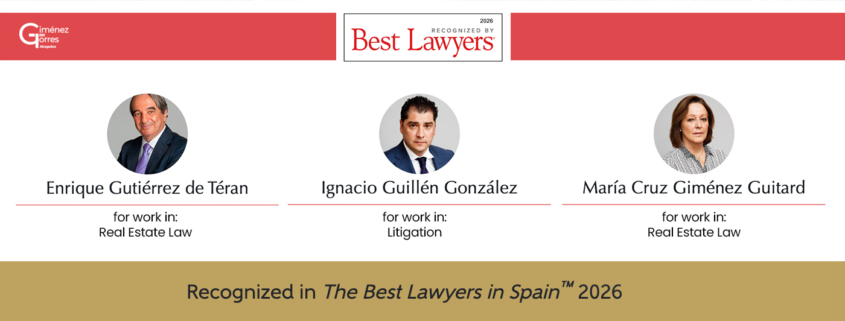
We are proud to announce that three of our partners have been recognized in the 2026 edition of The Best Lawyers in Spain, a leading international benchmark in the legal sector.

Real Estate Law:

  • Enrique Gutiérrez de Téran (since 2024)
  • María Cruz Giménez Guitard (since 2024)

Litigation:

  • Ignacio Guillén González (since 2025)

We maintain our recognition for another year in our Real Estate and Litigation practices, reaffirming our commitment to quality, technical excellence, and personalized attention


References:

The Best Lawyers in Spain 2026 – Enrique
The Best Lawyers in Spain 2026 – María Cruz
The Best Lawyers in Spain 2026 – Ignacio

Last week, Borja Uzquiano, one of our lawyers, had the opportunity to participate in The Academy, an intensive international legal training program organized by Multilaw. The program took place in Thailand, starting on July 20, and lasted for seven days.

Borja enjoyed several days of learning and connecting with colleagues from around the world — truly an enriching experience that strengthens our commitment to professional excellence and international collaboration.

On 18 November, the Supreme Court, sitting in plenary and unanimously, ruled that the employer must offer the employee the possibility of defending himself against the charges brought against him, before adopting the termination of the employment contract for disciplinary dismissal.

The basis for this change in the High Court’s criteria is the new interpretation of Article 7 of ILO (International Labour Organisation) Convention No. 158 of 1982 (in force in Spain since 1986), which is now understood to be directly applicable, without the need for any legislative change. This article establishes that:

“An employee’s employment shall not be terminated on grounds relating to his or her conduct or performance before he or she has been given an opportunity to defend himself or herself against the charges against him or her, unless the employer cannot reasonably be required to give him or her such an opportunity”.

It should be noted that the article itself provides for an exception to this requirement, which is that prior notification may not be required for justified reasons. In this regard, the judgment itself states that it will be necessary to consider the specific case in order to analyse whether or not this exception can be applied.

Compliance with this new requirement is only enforceable since the publication of the aforementioned ruling, and does not affect dismissals carried out prior to that date;
however, given the lack of clarity of the obligation, in terms of formalities, deadlines and consequences in cases of non-compliance, this currently generates great legal uncertainty for companies that intend to dismiss their employees for disciplinary reasons, as long as the requirements are not developed through case law or future legislative reforms.

The full sentence can be consulted at the following link.

On 29 October 2024, Royal Decree 1101/2024 came into force, approving the Statute governing the Independent Whistleblower Protection Authority (A.A.I.), in compliance with Final Provision Eleven of Law 2/2023, of 20 February, on the protection of persons who report regulatory infringements and the fight against corruption, and thus strengthening the fight against corruption in line with Directive (EU) 2019/1937.

This A.A.I. is a body that must act independently from other public authorities, with its own legal personality and autonomy in decision-making. Its main functions are to manage the external communications channel, to safeguard whistleblowers and promote their protection, both in the public and private spheres, and to enforce compliance with the obligations established in Law 2/2023, carrying out the tasks of information, advice and sanction, if necessary.

This Royal Decree represents a major step forward in the protection of whistleblowers in Spain, contributing to a legal environment that favours the detection and prevention of crimes and corrupt practices. With its arrival, we are very close to the expected and definitive commissioning of the A.A.I., which will bring with it various consequences such as the clarification of controversies in the interpretation of Law 2/2023, the star-up of the External Communication Channel or the imposition of sanctions for non-compliance, among others.

In the short term, the first consequences of the commissioning of the A.A.I., which until now was seen as something very distant, will be, on the one hand, the obligation for companies to have the channel implemented and in operation, complying with the requirements of the Law, and, and, on the other hand, the duty to communicate the Manager of the Internal Reporting Channel.

Despite the fact that Law 2/2023 established a period of ten (10) working days to notify the Manager of the Internal Reporting Channel, this delay in the creation of the A.A.I., has supposed that Royal Decree 1101/2024, which now comes into force, contemplates a change in this period, now establishing two (2) months “from the date the A.A.I. is put into operation” to notify the A.A.I. of the Manager of the Internal Reporting Channel.

We must focus on the term “commissioning of the A.A.I.” in Royal Decree 1101/2024, since, in order for this commissioning to be possible, as established in Law 2/2023, a new Royal Decree must be published to establish its effective start-up and its internal organisation chart. This Royal Decree has not yet arrived, so we must understand that the two (2) month period has not yet begun to run. Furthermore, as of today, there is no channel or website for the communication of those Managers at national level, which indicates that it is not yet operational. Even so, we will have to keep an eye on it, as it will be up and running very soon.

Thanks to the approval of this Royal Decree, and the Statute included in it, we are very close to the final objective, the definitive appointment at national level of the A.A.I., which will assume the tasks of advice, information, protection, investigation and, if necessary, sanction, with independence and autonomy, despite maintaining the delegation to the Autonomous Communities of certain specific tasks, as indicated in the Statute itself.

Download PDF: Nota informacion RD 1101-2024 aprobacion Estatutos AAI 13.11.24 EN

We have advised Royal Metropolitan, a Spanish real estate investor and asset management, in transaction with a total value of € 46 million, closed last week.

Our work focused on the drafting and negotiation of the transaction documents for the divestment of an office building in the centre of Madrid, CBD (Castellana/Barrio de Justicia area), whose acquirer, an investment fund, is going to change its use to residential.
This building is currently used as offices, fully leased and occupied by first class companies, and we have been successful in coordinating and negotiating its vacancy so that the buyer can develop the refurbishment project and conversion of the asset to residential use.
Our team has been led by our partner Enrique Gutiérrez de Terán head of our Retal Estate practice.

We have longstanding experience in all kinds of real estate transactions (purchases and sales of both real estate assets and investment vehicles, contributions, leases, purchase and sale of projects – forward purchases, etc.), for all client profiles (funds and venture capital, private individuals, family offices, international, institutional and equity investors, developers and financiers, builders, consultants and real estate practitioners, such as architects, engineers, project managers and estate agents), with respect to all types of property (office, residential, industrial, tertiary, land, ongoing developments, main residences and second homes, turnkey projects, real estate asset portfolios, etc.) and at all stages of the building process (land acquisition, planning and management, construction and marketing of the finished product).

Madrid, 6 November, 2024.

On July 2nd, 2024, Royal Decree 612/2024 was approved, amending Royal Decree 665/1997 of May 12, 1997, on the protection of workers against risks related to exposure to carcinogenic agents at work.

The aforementioned Royal Decree 665/1997, a basic regulation on occupational risk prevention, addresses the measures for the protection of workers against risks related to exposure to carcinogenic and mutagenic agents in the workplace which are commonly present in industry such as asbestos, lead, or silica. Establishing specific obligations for employers to act on the risks related to hazardous agents, ensuring risk assessment and the implementation of appropriate preventive measures with the aim of guaranteeing occupational health and safety.

➤ DOWNLOAD (PDF): Exposure workers carcinogens

 The modification of the paid leaves’ regime, derived from the entry into force of Royal Decree-Law 5/2023 of 28 June, established new minimum paid leaves to care for sick children and family members and to reconcile personal and family life regulated in article 37.3 of Royal Decree 2/2015 of 23 October, approving the Workers’ Statute Law (“WSL”, hereinafter), giving rise to multiple doubts as to its effective application. 

➤ DOWNLOAD (PDF): CURRENT_REGULATION OF_PAID_LEAVES

The reform of the appeal in cassation in the different jurisdictional orders.

Last 29th of June, Royal Decree-Law 5/2023 of 28 June was published in the Official State Gazette (“BOE”), introducing various reforms to the rules regulations proceedings in the different jurisdictional orders.

The reform of the appeal in cassation in the different jurisdictional orders. Download>

Last Tuesday, 21st February 2023, the Law 2/2023, of 20 February, was published in the Official State Gazette (BOE) as a transposition of the Whistleblowing Directive, which regulates the protection at EU level of persons who report breaches of EU Law. The Law will enter into force 20 days after its publication in the Official State Gazette, i.e. on 13th March 2023.

 ➤ Download Law 2-2023 of February 20, 2023